Wednesday, March 15, 2017

Songs Made From Loops (Within DAW) Make Great Vehicles for Improvisation

Within your DAW (Digital Audio Workstation) software, there typically exists a media library full of various midi and audio loops. When searching for something new to improvise over, I occasionally leverage these loop fragments, combine them into a song and hit it! Sunday afternoon (weather and sports permitting) I usually find myself in the mood to practice phrasing or improvise.

Here's a mis-mash of audio loops in Eb combined in Cubase v8.5.

Enjoy.


New! Instrumental, Rock Guitar CD Now Available (Eric Peterson 'Silly String')

I've just released my second CD for 2017, an instrumental, rock guitar recording. The songs on the album encompass song ideas and riffs from 2010-2016. These songs were left incomplete and never released as I was finishing my Bachelor and Master's degrees in IT Security. I'm happy to have finished and closed this life's chapter and hope you'll take a listen, and/or download a song or two.

I wanted to keep the recording fairly 'raw' and punchy, with a lot of melodic soloing,  and less guitar pyro-technics. I did my own production and graphic art/design (as usual) but feel the work was worth it.

Here's a direct link to the CD page. https://www.cdbaby.com/cd/ericpeterson3

The songs will be available from iTunes and other digital music outlets over the next few days. Thanks again for listening and supporting my music.

Enjoy.

Friday, March 3, 2017

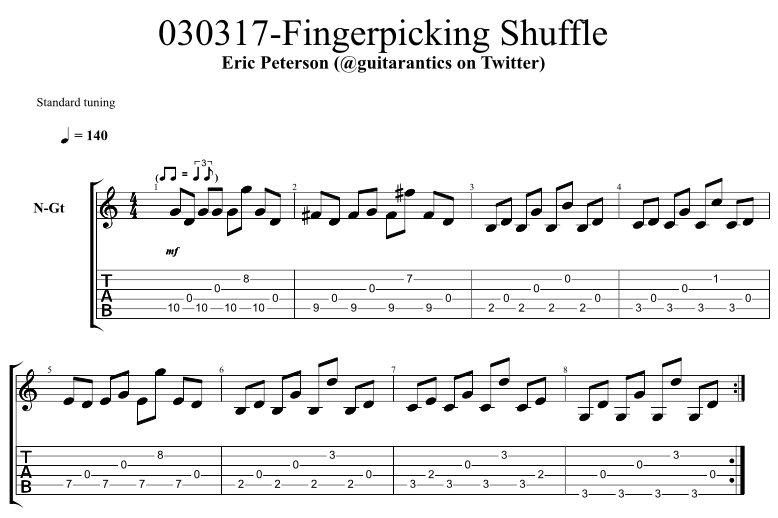
Fingerpicking Shuffle (3/3/17)

While watching sports, I often have a #guitar in my hand. The little ditties I compose are rarely the coolest thing ever (I'm watching TV), but I like to capture and catalogue them just the same. Here's a fingerpick shuffle spawned today while watching the NFL combine. Enjoy.

PDF Download


Thursday, March 2, 2017

Voice Leading Exercise (3/1/17)

Here's a new voice leading exercise for you to practice this month. Voice leading pertains to notes kept within the same voice (bottom, mid, top for example) from one chord to the next. I often try to find new ways to change chords and it often starts with voice leading - Download the PDF


Wednesday, February 22, 2017

Leveraging Other Instruments to Build Guitar Speed

After hearing violin virtuosos tear through Paganini caprices, I knew violin music would be fun to play on the guitar. Around this same time, the movie Crossroads came out, featuring Steve Vai and incorporating a section from Paganini's 5th caprice in a guitar duel.

I've continued to transcribe violin music over the years, and believe it to be interesting and helpful in inspiring new ideas and practice material (sequences, arpeggios, etc.) plus building up right hand speed (picking).


Here's a line from Kreutzer's 42 studies for the Violin at 180 bpm - Download the PDF. Enjoy.


Video explanation and illustration of the lick.


New Instrumental, Rock CD Almost Complete (release date in March 2017)

My new instrumental, rock CD is almost complete! I've finished the recording, mixing, and am currently mastering the songs and performing some final tweaks. The artwork is underway and the song titling process has begun.

The majority of the songs (13) are from the last 6 years or so while was finishing my Bachelors and Masters Degrees in IT Security. School preempted me from much composing or recording. I think you will really like this recording, it's edgy but melodic. I incorporated the nylon string (classical) guitar in this one. Videos of various licks from the CD can be found on my YouTube Page, here's an example. Enjoy.


New instrumental, Acoustic Guitar CD 'Glare' Now Available.


Eric Peterson 'Glare' CD Cover

1/31/17 - My latest recording is an instrumental, acoustic guitar CD called 'Glare', available anywhere you buy or download music. Here's a direct link https://www.cdbaby.com/cd/ericpeterson2.

There are many exciting aspects to this recording, one being a heavy use of my nylon string (classical) guitar for the solos and melodies. I enjoyed finding the 'sweet spot' for the microphone and keeping it set up for ease of daily recording. Secondly, I believe my recording, mixing, and mastering of the CD really turned out professionally and you'll enjoy the quality.


Saturday, June 18, 2016

Ten No-Brainer Guitar Tips for the Beginner

Ten No-Brainer Guitar Tips for the Beginner

1.    Choose a pick type, thickness, and color and stick with it. I've been using the same sort of picks, both in size and makeup since 1986. I'm not sure how I came across these but knew they felt good and were thick enough to play rock guitar, plus I could see them in the dark. What are they? Dunlop .96 mm Delrin picks.

2.    Learn to play finger style (just your fingers, no pick). There's more to playing the guitar than what you can play just using a pick. Learning how to finger pick will open up so many new sounds and possibilities, and you'll be amazed. I like to teach students the right-hand methodology and technique from a classical guitar viewpoint. There are many quality methods, however, so choose one, i.e. Christopher Parkening, Berklee Book Series, etc. Start with the exercises listed on the 'acoustic guitar lessons' page which also incorporate classical guitar.

3.    Learn to read music. There are so many reasons to read guitar music, and understanding rhythm notation to list them here. Just know that not being able to read will hinder your learning different styles, becoming a studio musician, limit your options once in college, etc.

4.    Compose original songs. Typically, your choices of demonstrating you can play the guitar are through live performance (solo or as part of a group or band), or you can record yourself (for others to hear) and publish your songs yourself. If you only play for yourself, and no one ever hears you or shares your musical gift, you're missing a rewarding aspect to being a musician. I enjoy composing and recording more than playing live and hope to finish my 19th CD in 2016.

5.    Play in a band (at least once). You may not enjoy performing as much as some, but you should join and play in a group at least once in life. Play some gigs, travel, set up and break down all the gear, market yourself and your band. It's a lot of work, and if you double as the sound guy (plus own all the PA gear), it's a specially big challenge. You may also triple as the recording engineer for your band, producing the demo CD. Sound familiar?

6.    Learn how to run sound, become a sound man. We've all heard ear-piercing feedback at a live show or event, have you wished you could fix it? A good sound guy can make or break your sound and the success of your gig. Learn how to control feedback using EQ, volume, and position of microphones to monitors. Explore how all the PA components connect and work together. Learn about compression, effects loops, groups and inserts.

7.    Learn how to record your songs and/or your band's songs at home. Put together your studio and DAW (digital audio workstation). There's nothing like being able to save the money and record and produce the CD yourself! There will be a high learning curve and upfront investment, but in the long run, you'll be the happiest recording and releasing your recordings.

8.    Appreciate excellent drummers, they are amazing! I've had the pleasure of working with a couple of really great drummers. What made them great you ask? Firstly, not requiring me to chart out the entire tune so they can play (at all), and being proficient enough to make up parts of the fly. Hearing what they naturally came up with has always been part of the excitement. Also, when you hear them accenting particular nuances of your guitar part, you'll know they're hearing what you're playing. When they pick up on the exact 'vibe' you heard in your head and intended for the song; you'll know you found a keeper. Appreciate good drummers.

9.    Teach someone guitar. Teaching is the fastest, and best way to see what you know and whether you can explain it or not. I started teaching at age 16 while a sophomore in High School. I found that if I could explain a music theory concept to a friend, that meant I understood it enough to apply it in my playing and build on its foundation.

10.    Develop your ear, and practice ear training. Ear training is invaluable, and I believe everyone can develop relative pitch. If you can hum a tune or melody and recreate it on the guitar (through searching for the notes), you already have decent pitch! Now expand your ear training to the study of intervals and weekly practice using recording audio snippets. Many websites have ear training exercises, locate one and see how you fair (finding the notes).
~Eric Peterson

Why Do You Play the Guitar?

Why do you play the guitar? I enjoy asking this question of great players I meet plus my guitar students. You may not remember why, or how you started, and that's okay. However, if you can recall, what was your inspiration to play? Think about these - Did you have a friend that played? Did you see a great live band or guitar player? Heaven forbid, did you think the guitar would make you famous? Any aspirations for greatness - did you want to be famous (I did)? Did you do what so many of us did and trade your air-guitar in for a real one? ~There are so many reasons for wanting to play the guitar, I'd love to know why, please share your story as a comment on this page. Do you remember when you made the decision to play and play well? What was your first guitar? These are all questions that are fun to discuss and remember.

~Eric Peterson

Tuesday, May 3, 2016

More Posts on the Way.

I've decided to disband another guitar-oriented website, this time it's whyplayguitar.com. I get tired of paying the hosting fees and end up using free blogs for a while. Anyway, you'll be the benefactor shortly!

Wednesday, June 18, 2014

Diminished Exercise in 6/8

Diminished patterns are interesting sounding, and fun to play. They only have four notes, so they're not considered a scale. The formula is 1 b3 b5 6 and the patterns repeat every minor third (four frets).


Practice to a metronome set between 110-130 bpm repeating repetitiously. The next starting position for this example would be fret 11, then 2 (or 14), then fret 5. Enjoy!

PDF download HERE.

Saturday, February 22, 2014

Sequencing Using Different Scale Types

Practicing scale sequences with different scale types is very helpful, both from an exercise perspective, and a phrasing perspective. Try this example utilizing four different scale types in the same position.


Sunday, February 9, 2014

Don't forget the humidity.

I hope you're not someone who forgets that during the winter the heat makes the air dry, causing your guitars some serious issues. Many guitarists still use guitar stands, and have one close to a heat vent. Do you have guitars buzzing or playing strangely? Have you checked the neck, action, and top of the guitar to see if its starting to cave in? The next step after a concave top is the bridge coming unglued, then the damage is done, might as well sell it cheap or use it for the campfire guitar.

A small to medium room humidifier works great, plus a battery-powered temperature and humidity sensor. The desirable range is between 35-40% humidity.
There are many great articles and books on performing maintenance on your guitars, including neck adjustment and regular care. Since your acoustic guitar by Taylor, Martin, Larrivee, or other accounts for a size-able amount of money, you'd be wise to get in the 'time to fill the humidifier' habit.


Sunday, January 26, 2014

Sequences - the path to accurate picking.

Scale sequences are fundamental to accurate picking and I highly recommend practicing them on a regular basis.These examples are in the key of G and utilize alternate picking.